
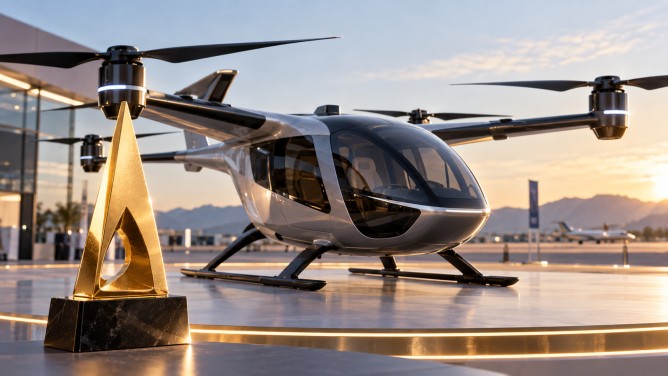
The Hydrone Xc05, a hydrogen-powered unmanned aerial vehicle (UAV) developed by Tianmushan Laboratory, has been awarded the prestigious Gold A’ Design Award in the Aerospace and Aircraft Design category. This recognition highlights the UAV’s innovative design, intended for long-range missions in harsh environments. The A’ Design Award is an international competition that evaluates designs through a blind peer-review process conducted by professionals across design, aviation, and academic fields. This accolade places the Hydrone Xc05 among the top designs in the aerospace category.
The Hydrone Xc05’s development focuses on hydrogen propulsion and autonomous flight technologies, allowing it to operate for up to three hours and travel over 100 kilometers beyond visual line of sight. Its low-temperature capability supports operations at temperatures as low as -40°C. One standout feature of the UAV is its detachable fuel-cell system, enabling it to switch between hydrogen and electric propulsion modes, thereby offering greater adaptability to varying operational demands.
Incorporating AI-based aviation models, the Hydrone Xc05 is equipped with laser and visual navigation technologies, facilitating autonomous flight without the need for continuous manual control or reliance on satellite signals. Its carbon-fiber airframe and aerodynamic design contribute to its efficiency, while foldable arms and landing gear significantly reduce its storage volume by about 70%, enhancing ease of transport and deployment.
Key members of the development team include Weiqiang Xu, Ding Gao, Qing Shi, Jian Wang, Zhigang Zeng, and Liang Cheng, who played crucial roles in the aircraft’s engineering and design development. Tianmushan Laboratory, situated in Zhejiang Province, China, and associated with Beihang University and its Sino-French School of Aeronautics, is dedicated to aerospace research. Its expertise spans green aircraft design, aviation propulsion, advanced aerospace materials, intelligent flight management, and onboard energy systems.
The laboratory views this award as further acknowledgment of its advancements in hydrogen propulsion, autonomous aviation, and cutting-edge aircraft technologies designed for challenging operational conditions. More details about the award-winning project can be found on the A’ Design Award website. The award itself covers multiple industries and design disciplines, with the Aerospace and Aircraft Design category focusing on technology integration, aircraft performance, safety, efficiency, environmental considerations, materials, and manufacturing.
Legal Disclaimer:
The information contained in this article has been provided by independent third-party contributors, clients, or content partners. We do not independently verify the accuracy, completeness, legality, ownership, licensing, or reliability of submitted content, including text, images, videos, trademarks, or other media materials. The submitting party is solely responsible for ensuring that all content, including images and media assets, complies with applicable copyright, trademark, licensing, and intellectual property laws. We disclaim liability for any unauthorized use of copyrighted or proprietary materials by third parties. If you believe that any content published on this platform infringes your intellectual property rights, kindly contact the author above for prompt review and resolution.