
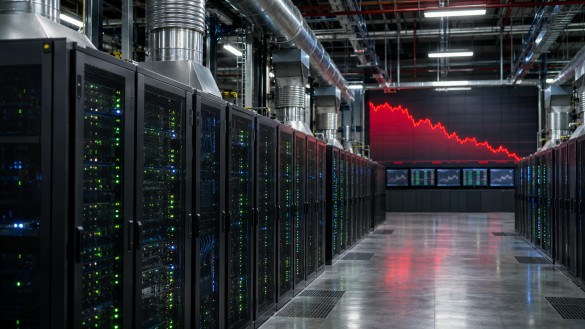
Investor concerns over the future of artificial intelligence (AI) data centers led to a significant sell-off in technology stocks on Wall Street. Following the U.S. midterm elections, uncertainty about regulatory changes surrounding data center developments created apprehension among investors, leading to sharp declines in the Nasdaq Composite.
Semiconductor companies, key suppliers for AI data centers, were among the hardest hit. Nvidia’s shares plummeted over 6%, while Advanced Micro Devices (AMD) and Micron Technology saw drops of 12% and 11%, respectively. These companies have been heavily reliant on the growth in AI data center investments, which are now facing potential setbacks due to increased political resistance.
The midterm elections saw the rise of several candidates who are advocating for restrictions or halts on new data center projects. Their concerns focus on the energy consumption, infrastructure demands, and local community impacts associated with these large-scale developments. This political shift has consequently weakened investor confidence in AI-related stocks, which had previously been top performers.
In addition to the technology sector’s turmoil, a rebound in oil prices added further pressure to financial markets. Brent crude rose by 2.3% to $96.79 per barrel, while U.S. West Texas Intermediate crude increased by 2.4% to $90.26. The recovery in oil prices came amidst expectations of potential diplomatic efforts to resolve tensions with Iran.
Globally, the impact was felt beyond U.S. shores. European markets experienced mixed results, with major indexes in London and Frankfurt closing lower despite initial gains post-election results. In Asia, South Korea’s benchmark index faced a decline of more than 5%, reflecting the widespread investor anxiety.
The latest market dynamics underscore the growing uncertainties surrounding AI investments and regulatory environments, alongside fluctuating conditions in global energy markets. Investors are now navigating a complex landscape where political developments and energy price shifts are increasingly influencing market trajectories.