
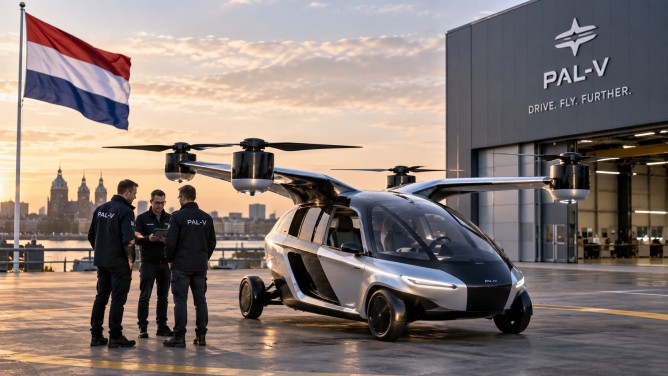
The European Union Aviation Safety Agency (EASA) has granted approval to Dutch firm PAL-V to commence production of aviation components for its innovative flying car, the Liberty. This development marks a significant step towards the commercial availability of the Liberty, as the company moves closer to making its flying car a reality.
This approval permits PAL-V to produce the aircraft-specific parts of the Liberty, a three-wheeled vehicle designed to transition seamlessly between road and air travel. The vehicle is equipped with a retractable rotor and propeller, allowing it to drive like a conventional car on the ground while transforming into an aircraft for flight. Unlike helicopters, the Liberty requires a runway for both takeoff and landing, as it cannot take off vertically.
Looking ahead, PAL-V’s next crucial milestone is obtaining certification for the Liberty as a complete aircraft, which is anticipated by 2028. Achieving this certification would legally authorize the Liberty to operate in the skies. The vehicle’s design necessitates both a driving licence and a pilot’s licence from its operators. On the road, it can achieve speeds of up to 160 km/h, and it boasts an approximate flying range of 500 kilometers.
With a starting price of around €299,000, excluding taxes and additional costs, the Liberty has already attracted significant interest. PAL-V reports that the first 250 units have been sold, with orders including those from the Dutch fire brigade, highlighting the potential demand for this pioneering mode of transportation.
If PAL-V secures the final aviation certification as planned, the skies could see the Liberty flying cars in operation by 2028, marking a new era in personal and emergency air mobility.